New Moon and Full Moon: The Difference and How to Observe the Cycle
Moon phases have an astronomical explanation; in astrology they are read as symbols of beginning and culmination. Telling both views apart makes observation more interesting.
Vivida Editorial
The new Moon and the full Moon are often tied to different emotions and rituals. Before assigning them meaning, it is worth understanding what we actually see in the sky: the Moon does not shine on its own; it reflects sunlight. From Earth we see varying amounts of that lit portion because the Moon moves around the Earth.
What happens at the new Moon?
At the new Moon the side facing us is almost unlit by the Sun, so the Moon is hard to see. This is the astronomical start of the cycle. In astrological language it is often used as a symbol of a new intention or undertaking.
If this symbol is useful to you, pick one small, measurable intention: "twice this week I will walk for ten minutes in the evening." The Moon does not carry out such a plan — you do.
What happens at the full Moon?
At the full Moon the side facing us appears almost fully sunlit. In astrological and cultural practices this phase is often linked to summing up, completion, and seeing what has already grown.
You can ask yourself three questions: what worked? What changed? What will I no longer continue in the same form? Personal experience answers these questions, not the Moon phase.
The cycle is more than two dates
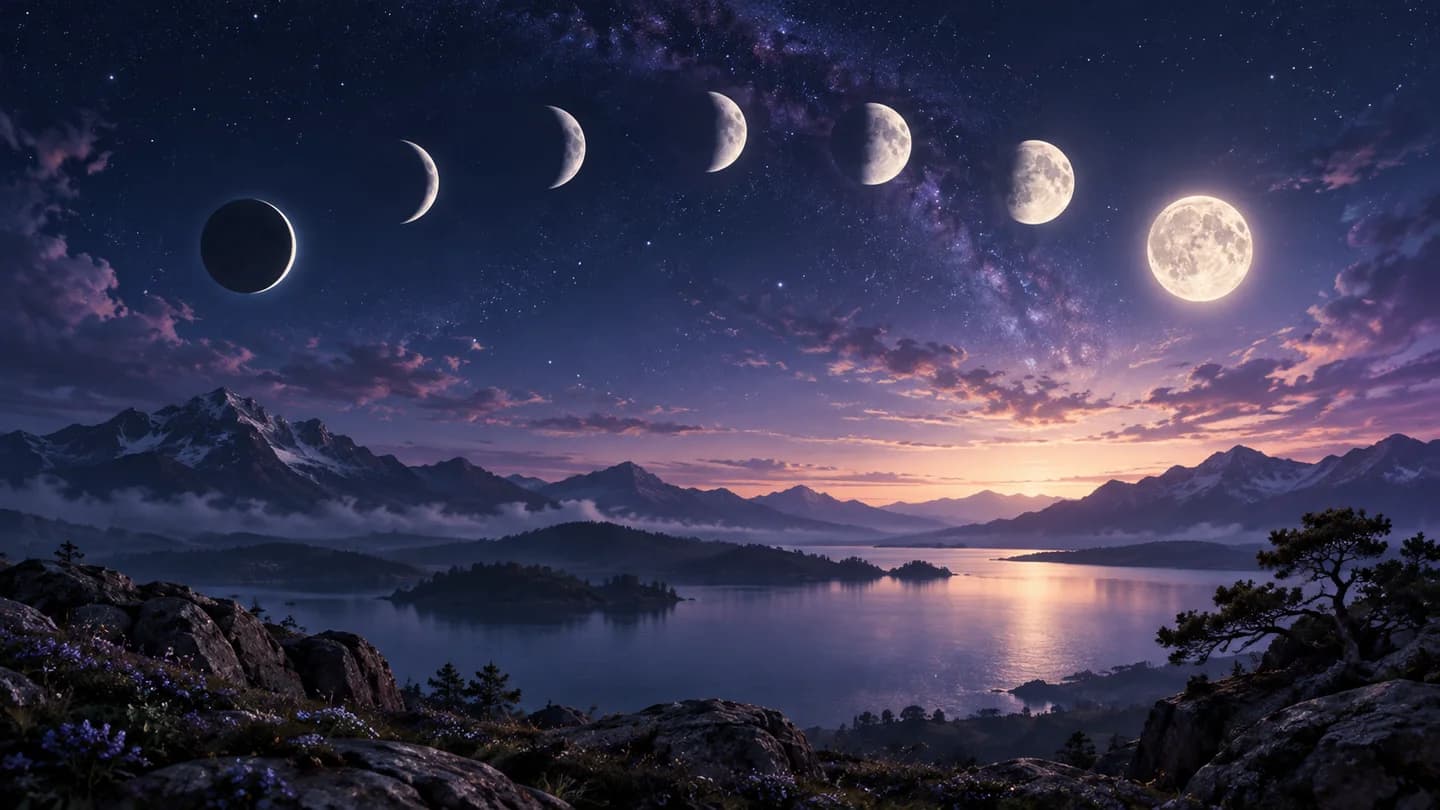
Between the new and full Moon we see waxing phases; after the full Moon the lit portion gradually shrinks. So observing the cycle can help you see the rhythm of change rather than one-day "miraculous" events.
For one month, try a simple log: phase, weather, your bedtime, and the day's main activity. Then look at what can be explained by ordinary circumstances. That makes the observation more honest.
What the Moon phase does not mean
A phase is no guarantee that a particular event will happen, or that everyone feels the same thing. If sleep, mood, or health troubles you, assess causes through real circumstances — and through conversation with a specialist when needed.
A celestial cycle can be a beautiful way to mark time; your decisions remain in your hands.
To see dates, use the Moon calendar and the new Moon and full Moon pages. The astronomical explanation of the phases is in NASA's guide.
Astrological interpretations are for reflection. They are not scientific predictions or a basis for medical, financial, or other important decisions.